
Wettbewerbsvorteile durch die ISO 27001 Zertifizierung

Unlock Trust with ISO 27001
ISO 27001 is an international standard for information security management systems (ISMS) that helps organizations protect data, manage cyber risks, and demonstrate a structured approach to information security. This article explains how ISO 27001 creates measurable competitive advantages—improving customer trust, opening procurement opportunities, and strengthening operational resilience—by linking governance, controls, and business outcomes. Readers will learn the primary benefits of certification, how certification differentiates firms in tenders and markets, the ISMS lifecycle for risk mitigation, and practical compliance mappings to GDPR and NIS 2.0. The guide also outlines what expert support looks like for achieving certification and summarizes real-world success stories that show business impact. Throughout, we integrate practical checklists, EAV tables, and actionable lists to help security leaders, procurement teams, and technical managers plan certification with clarity and purpose.
What Are the Key Benefits of ISO 27001 Certification for Businesses?
ISO 27001 certification delivers structured information security through an ISMS that aligns controls with business risks, producing tangible outcomes such as improved trust, reduced incident costs, and smoother procurement. The standard works by requiring documented risk assessment, control selection (Annex A), and continual improvement, which together reduce uncertainty for customers and partners. Organizations gain clearer evidence for due diligence, more predictable incident response, and a repeatable governance framework that supports business continuity. Below are the primary benefits, each tied to how organizations realize measurable impact.
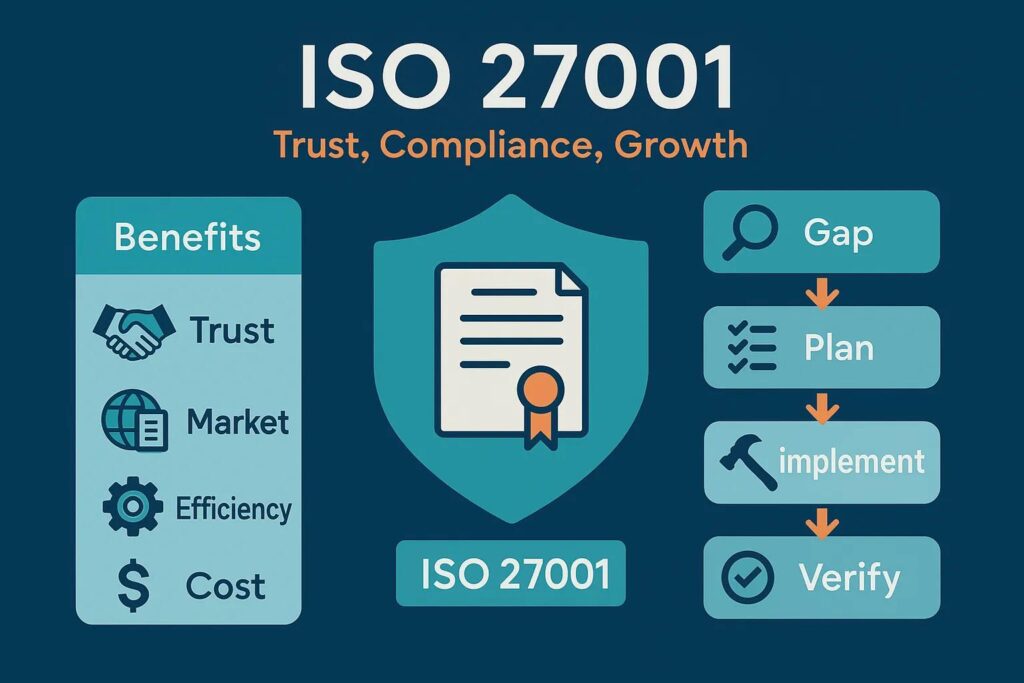
ISO 27001 offers several direct business benefits:
- Trust and Customer Assurance: Independent certification signals verified controls and transparency to clients and partners.
- Market Access and Procurement Wins: Certification often shortens procurement due diligence and meets supplier requirements in regulated tenders.
- Cost Avoidance and Reduced Incident Impact: Structured risk treatment reduces remediation time and recovery costs.
- Operational Efficiency: Standardized processes lower audit overhead and streamline security governance.
- Supply-chain Assurance: Certification supports third-party risk management and supplier cascades.
These benefits translate into measurable business outcomes such as faster contract awards and fewer disruptive incidents, which we explore next in an evidence mapping.
Different benefits map to business evidence and impact in predictable ways:
| Benefit | Evidence | Business Impact |
|---|---|---|
| Trust and Customer Assurance | Certificate, ISMS scope statement, audit reports | Higher RFP win rates and deeper client relationships |
| Market Access and Procurement Wins | Supplier declarations, compliant controls list | Faster onboarding and access to regulated tenders |
| Cost Avoidance | Incident metrics and remediation logs | Lower breach remediation costs and insurance premiums |
| Operational Efficiency | Standard operating procedures, reduced duplicate audits | Reduced audit time and internal resource savings |
| Supply-chain Assurance | Supplier risk assessments and cascade controls | Improved supplier continuity and contractual compliance |
This table helps security leaders prioritize which benefit to emphasize when communicating value to sales, procurement, and executive stakeholders. After understanding these benefits, many organizations seek practical help to translate them into procurement wins and risk-reduction metrics; specialized advisors can support that transition with targeted gap analyses and documentation support.
ACATO GmbH brings domain experience in IT security, data protection, forensics, and data recovery to ISO 27001 advisory services, focusing on certification readiness, proactive risk management, and audit preparation while guiding organizations through procurement and regulatory expectations. For readers considering external support, the following sections detail how certification differentiates a business in the market and what expert assistance typically includes.
How Does ISO 27001 Enhance Customer Trust and Loyalty?
ISO 27001 enhances customer trust by providing an independently verified framework that demonstrates an organization’s commitment to protecting information assets and handling incidents responsibly. Customers and partners perceive certification as a reliable proof artifact that reduces perceived third-party risk during procurement and long-term vendor selection. This formal assurance supports retention because existing clients face lower perceived operational risk when renewing services, and procurement teams use certificates to shorten vendor validation cycles. Clear communication of ISMS scope and controls further strengthens trust by making confidentiality, integrity, and availability commitments explicit.
Organizations can leverage certification announcements, client briefings, and tailored evidence packages to convert trust into loyalty and upsell opportunities. The next subsection quantifies operational efficiencies and cost savings that reinforce trust through economic impact.
What Cost Savings and Operational Efficiencies Result from ISO 27001?
ISO 27001 drives savings through repeatable processes that reduce incident response time, lower audit preparation costs, and minimize duplicate evidence requests from customers and regulators. By standardizing documentation—policies, risk registers, and monitoring reports—teams spend less time preparing for audits and responding to ad-hoc due diligence, freeing resources for strategic security improvements. Insurance premiums and third-party risk assessments can also be favorably impacted when organizations demonstrate consistent control implementation and measurable incident reduction.
Key KPIs to track savings include mean time to detect (MTTD), mean time to recover (MTTR), number of audit hours per quarter, and percentage reduction in duplicate evidence requests. Tracking these KPIs lets organizations calculate an ISO 27001 ROI by comparing certification-related savings against implementation and maintenance costs, forming a clear business case for leadership.
How Can ISO 27001 Certification Differentiate Your Business in the Market?
ISO 27001 differentiates businesses by turning information security from a technical claim into verifiable, management-level assurance that procurement teams and customers can evaluate objectively. The standard provides artifacts—certificates, audited control lists, and an ISMS scope—that sales and marketing teams can use in pitches and tenders to reduce buyer friction. By aligning security with commercial objectives, certification converts risk mitigation into competitive advantage and serves as a gating factor for regulated sectors and government procurement.
Below are practical ways certification can be activated for market differentiation:
- Use certification in procurement responses to shorten due diligence timelines.
- Present ISMS scope and control summaries in RFPs to meet supplier assurance criteria.
- Incorporate certification claims into targeted sector marketing for regulated industries.
These actions create measurable differentiation that procurement teams recognize, which leads to additional contract opportunities and expedited onboarding for certified suppliers.
ISO 27001 Framework for Government Procurement Security
ABSTRACT: AbstractCertification Government Procurement of Goods/Services has applied since 2008 and switched to certification-based computers in 2015. However, technology information has raised problems with the security of necessary information fixed, like illegal access and practice jockeying through access remotely against application exam-based computers. To overcome the challenge, a framework Works security comprehensive information is required. In a study, the researcher compares System Certification Quality Management with Standard ISO 27001:2022 and observes Suite implementation certification procurement to develop a framework special can implement in system certification. Analysis results show that LKPP requires framework Work security information on the system certification procurement goods/services government based on the ISO 27001: 2022 standard. The proposed framework aims to facilitate application Certification Procurement by LKPP as institution-maker regulation and impleme
Recommendations for designing information security framework in government procurement of goods/services certification systems based on ISO 27001: 2022, M Salman, 2022
Which New Business Opportunities and Government Contracts Does ISO 27001 Unlock?
ISO 27001 is commonly required or strongly preferred in tenders for government agencies, critical infrastructure suppliers, finance, healthcare, and large enterprise supply chains where data protection and continuity are critical. Certification frequently unlocks frameworks and call-offs where supplier assurance is a precondition, and it reduces the time spent on security questionnaires and supplier vetting. Proof artifacts that accelerate these processes include the certificate itself, a concise ISMS scope statement, risk treatment summaries, and, where applicable, third-party audit summaries.
Preparing these artifacts ahead of bidding reduces procurement friction and improves responsiveness to tenders. The next subsection explains how certification supports brand reputation and long-term market positioning.
How Does ISO 27001 Improve Brand Reputation and Market Position?
Certification improves brand reputation by signaling governance maturity and operational discipline, enabling companies to position themselves as trusted partners in industries sensitive to data security. Communications frameworks that link certification to client outcomes—such as reduced downtime or secure processing of regulated data—help sales teams convert trust into tangible commercial gains. Reputation KPIs to monitor include changes in RFP win rate, customer churn, Net Promoter Score (NPS), and time-to-contract.
Implementing certification into marketing and sales collateral should prioritize verifiable claims and concrete artifacts to avoid vague assertions. Demonstrating measurable results from certification amplifies market positioning and supports sustained competitive differentiation.
Wie die ISO 27001-Zertifizierung Ihr Geschäft im Markt stärkt
ISO 27001 enables robust risk management by institutionalizing a Plan-Do-Check-Act cycle through an ISMS that systematically identifies risks, implements controls, monitors performance, and drives continual improvement. The ISMS lifecycle embeds security into organizational processes—context establishment, leadership and policy, planning, operational controls, performance evaluation, and improvement—so risk treatment becomes repeatable and auditable. This approach reduces the probability and impact of incidents while improving recovery capabilities and organizational resilience.
The next list summarizes the core ISMS steps that underpin this resilience and how they map to practical activities.
ISO 27001 implements the ISMS lifecycle in discrete steps:
- Identify: Define scope, assets, and threats through structured risk assessment.
- Assess: Prioritize risks by impact and likelihood using business-centric criteria.
- Treat: Select and implement controls from Annex A or other frameworks.
- Monitor & Improve: Measure control effectiveness, review incidents, and iterate.
What Role Does the Information Security Management System Play in Cyber Risk Mitigation?
The ISMS functions as an organizational mechanism to translate risk assessment into targeted controls, processes, and monitoring that reduce cyber exposure. By combining policies, technical controls, incident response, and performance metrics, an ISMS formalizes how risks are managed across people, process, and technology. Typical controls include access management, logging and monitoring, secure configuration, and incident handling procedures that directly reduce common threat vectors.
Monitoring KPIs such as time to detect, time to contain, and number of security incidents tracked over time demonstrates the ISMS’s effectiveness and supports continual improvement cycles that close gaps and bolster cyber resilience.
How Does ISO 27001 Help Ensure Business Continuity Amid Cyber Threats?
ISO 27001 supports business continuity by requiring documented incident response and recovery procedures that integrate with existing BC/DR planning, ensuring restoration priorities align with business-critical services. The ISMS enforces regular testing, backup validation, and supplier continuity checks that reduce downtime and preserve contractual service levels during incidents. Embedding continuity within the ISMS ensures recovery objectives are evidence-backed and auditable.
Aligning ISO 27001 controls with company BC/DR frameworks improves recovery times and helps maintain service continuity for customers, which in turn supports contractual obligations and reduces reputational damage during disruptions.
How Does ISO 27001 Certification Ensure Compliance with GDPR, NIS 2.0, and Other Regulations?
ISO 27001 is a voluntary management standard that aligns closely with regulatory requirements by prescribing documented controls and evidence trails that satisfy many obligations under GDPR and NIS 2.0. While regulations impose legal obligations and penalties, ISO 27001 provides a structured control environment, risk-based methodology, and audit evidence that reduce regulatory friction. Mapping clauses and controls helps compliance teams prioritize where ISO adoption covers regulator expectations and where additional measures are required.
The following table maps core regulations to ISO 27001 roles to clarify synergies and gaps.
| Regulation | Obligation | ISO 27001 Role |
|---|---|---|
| GDPR | Protect personal data, demonstrate lawful processing | ISMS policies, risk assessments, access controls, DPIA documentation |
| NIS 2.0 | Ensure network and information system security for operators of essential services | Risk management, incident reporting procedures, supply-chain assurance |
| Sector-specific rules | Specific technical or reporting requirements | Supplement ISO controls with sector-tailored measures and evidence |
What Are the Differences and Synergies Between ISO 27001 and Key Regulations?
ISO 27001 is voluntary and principles-based, focusing on management systems and continuous improvement, while regulations like GDPR and NIS 2.0 are mandatory and often prescriptive about specific obligations such as breach notification timelines or data subject rights. Synergies exist because ISO 27001 produces policies, risk registers, and documented controls that serve as audit evidence for regulators. Where gaps appear—such as the legal basis for processing under GDPR or specific incident notification formats under NIS 2.0—organizations should augment the ISMS with targeted procedures.
Practical alignment requires a small set of bridging controls and documented evidence that translate ISO outputs into regulatory compliance artifacts, reducing duplication and streamlining audits.
How Does Certification Reduce Audit Burden and Legal Liabilities?
Certification reduces audit burden by creating a single source of truth—documented policies, risk registers, control evidence, and incident logs—that both customers and regulators can inspect, lowering repetitive evidence requests. Audit-ready artifacts include the ISMS scope, Statement of Applicability, control implementation records, and internal audit reports, which together demonstrate due diligence. This documented due diligence can reduce legal risk by showing systematic efforts to identify and treat information risks.
| Regulation | Evidence Artifact | ISO 27001 Role |
|---|---|---|
| GDPR | DPIAs, processing records | Risk-based controls and documented procedures |
| NIS 2.0 | Incident reports, supplier assessments | ISMS incident management and third-party risk processes |
| Contractual audits | SOC-style control mappings | Statement of Applicability and control evidence |
What Expert Support Does ACATO Provide for Achieving ISO 27001 Certification?
ACATO GmbH offers specialized ISO 27001 consulting and certification support tailored to organizations preparing for certification, focusing on gap analyses, audit preparation, ISMS documentation, and awareness training. Their approach typically begins with an initial consultation to understand scope and regulatory context, followed by a structured gap analysis that maps current practices to ISO clauses and Annex A controls. Deliverables commonly include a remediation roadmap, template policies and procedures, risk assessment outputs, and targeted training for stakeholders to embed the ISMS into day-to-day operations.
The following table links core services to deliverables and expected business outcomes, illustrating practical value for decision-makers.
| Service | Deliverable | Business Outcome |
|---|---|---|
| Gap analysis | Gap report, remediation roadmap | Focused efforts, reduced time to certification |
| ISMS documentation | Policies, risk register, SoA templates | Consistent evidence for audits and procurement |
| Audit preparation | Mock audits, audit checklists | Fewer surprises during certification audits |
| Awareness training | Role-based training modules | Improved compliance behavior and reduced human error |
How Does ACATO’s Consulting Facilitate a Smooth Certification Process?
ACATO’s consulting typically follows a phased approach: assess → plan → implement → verify → certify, using templates and tools to accelerate documentation and reduce internal effort. Initial assessments identify scope and critical assets, while remediation plans sequence controls by business impact. During implementation, ACATO supports writing policies, populating the risk register, and preparing evidence packages for auditors. Mock audits and staff coaching reduce the likelihood of nonconformities and help internal teams own the ISMS after certification.
By coordinating stakeholder engagement and providing template-driven documentation, consultancies shorten timelines and reduce the internal resource burden necessary for certification readiness.
What Tailored Solutions Does ACATO Offer for SMEs, Corporations, and Authorities?
ACATO adapts scope and delivery to client type: for SMEs the focus is on lean ISMS scopes and prioritized controls to limit overhead; for corporations emphasis shifts to enterprise governance, supply-chain integration, and program-level reporting; for authorities the approach stresses compliance alignment, classified-data handling, and inter-agency coordination. Tailored packages include fixed-scope engagements for resource-constrained organizations and enterprise programs for larger firms with distributed responsibilities.
These personas guide realistic timelines and resource plans so organizations can pursue certification with clarity on effort and expected outcomes, improving the chance of timely and sustainable certification.
| Persona | Recommended Scope | Typical Timeline |
|---|---|---|
| SME | Focused business-critical systems | 6–9 months typical |
| Corporation | Enterprise ISMS, supply-chain integration | 9–18 months program |
| Authority | Compliance-heavy scope, inter-agency controls | Project-based, aligned to regulation cycles |
What Real-World Success Stories Demonstrate the Competitive Advantages of ISO 27001?
Real-world case summaries show certification converting security investment into measurable business outcomes such as higher win rates, reduced incident impacts, and smoother regulatory engagement. For example, organizations that adopted ISO 27001 often report faster procurement cycles and clearer evidence packages that shorten supplier onboarding. Public-sector entities benefit from strengthened inter-agency assurance and clearer classification handling, while commercial firms use certification to enter regulated markets and negotiate favorable contract terms. The lessons below extract patterns that other organizations can replicate.
Key lessons from successful ISO 27001 implementations:
- Leadership engagement and clear scope definition speed progress and reduce rework.
- Prioritizing critical assets and controls prevents resource overload and accelerates impact.
- Integrating ISMS with BC/DR and privacy programs multiplies resilience benefits.
How Have Clients Gained Market Growth and Trust Through ACATO’s ISO 27001 Services?
Clients guided through structured gap analysis, documentation support, and audit preparation have converted certification into market gains by using audit artifacts in tender responses and evidence packs, resulting in quicker procurement decisions and expanded sector access. Interventions typically include targeted awareness training to reduce human-related incidents and documentation templates that reduce auditor queries, producing measurable reductions in audit preparation time. These operational efficiencies, paired with credible certification claims, underpin increased confidence among clients and partners, which translates into contract wins and improved renewal rates.
Organizations considering certification can replicate these outcomes by combining prioritized remediation with stakeholder communications that emphasize verifiable control outcomes.
What Lessons Can Be Learned from Government and Industry Case Studies?
Across government and industry case studies the critical success factors are consistent: executive sponsorship, a narrowly defined initial scope, pragmatic prioritization of controls, and ongoing measurement of ISMS KPIs. Common pitfalls include attempting overly broad scopes at the outset and neglecting evidence artifact maintenance, both of which slow certification and reduce perceived value. Recommended next steps are to begin with a risk-driven scope, produce a minimal set of high-quality audit artifacts, and schedule regular internal audits to drive continual improvement.
Organizations that follow these steps can scale their ISMS across functions and supply chains while avoiding common implementation traps that undermine momentum.
For organizations seeking hands-on support, tailored training, or guidance on audit-ready artifacts, external advisory services can provide the templates, coaching, and mock audits needed to accelerate certification. Provide comprehensive information on IT security, data protection, forensics, and data recovery services; establish expertise; and generate leads for consulting, services, and academy enrollments.
Frequently Asked Questions
What is the process for obtaining ISO 27001 certification?
The process for obtaining ISO 27001 certification typically involves several key steps. First, organizations must conduct a gap analysis to assess their current information security management practices against the ISO 27001 standard. Next, they develop and implement an Information Security Management System (ISMS) that includes policies, risk assessments, and controls. After the ISMS is in place, organizations undergo an internal audit to ensure compliance. Finally, an external certification body conducts an audit to verify adherence to the standard, leading to certification if successful.
How long does it take to achieve ISO 27001 certification?
The time required to achieve ISO 27001 certification can vary significantly based on the organization’s size, complexity, and existing security practices. Generally, small to medium-sized enterprises may take between 6 to 9 months, while larger corporations might require 9 to 18 months. Factors influencing the timeline include the scope of the ISMS, the readiness of existing documentation, and the level of employee training and engagement. Organizations should plan for adequate time to address any gaps identified during the initial assessments.
What are the costs associated with ISO 27001 certification?
The costs associated with ISO 27001 certification can vary widely depending on several factors, including the size of the organization, the complexity of its operations, and the level of external consulting support required. Typical expenses include costs for gap analysis, training, documentation, and the certification audit itself. Organizations may also incur costs related to implementing necessary controls and ongoing maintenance of the ISMS. It’s essential to budget for both initial certification and ongoing compliance efforts to ensure long-term success.
Can ISO 27001 certification be maintained over time?
Yes, ISO 27001 certification can and should be maintained over time. Organizations are required to undergo regular surveillance audits, typically annually, to ensure continued compliance with the standard. Additionally, the ISMS must be continually improved based on performance evaluations, incident reports, and changes in the business environment. This ongoing commitment to information security not only helps maintain certification but also enhances the organization’s resilience against evolving cyber threats.
How does ISO 27001 certification impact employee training and awareness?
ISO 27001 certification significantly impacts employee training and awareness by necessitating a structured approach to information security education. Organizations must provide role-based training to ensure that employees understand their responsibilities regarding data protection and security protocols. This training fosters a culture of security awareness, reducing the likelihood of human error and enhancing overall compliance. Regular training sessions and updates are essential to keep staff informed about new threats and changes in policies, ensuring that security remains a priority across the organization.
What role does top management play in ISO 27001 certification?
Top management plays a crucial role in the success of ISO 27001 certification by demonstrating leadership and commitment to information security. Their involvement is essential for defining the scope of the ISMS, allocating resources, and fostering a culture of security within the organization. Management must also ensure that security objectives align with business goals and that employees are engaged in the process. By actively supporting the implementation and maintenance of the ISMS, top management helps drive continuous improvement and compliance with the standard.
Conclusion
Achieving ISO 27001 certification offers organizations a structured approach to information security that enhances customer trust, streamlines procurement processes, and mitigates risks effectively. By aligning security practices with business objectives, companies can unlock new market opportunities and demonstrate their commitment to data protection. For those ready to take the next step, consider exploring expert consulting services that can guide you through the certification journey. Elevate your business’s competitive edge and operational resilience today.